Posts

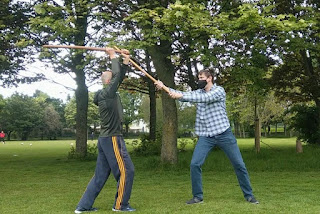
Outdoor practice in Dublin. 29 June 2021

Today we were four. Two persons have never touched a wooden sword before. So we did very basic exercises today.  Techniques covered: Ken-no-kamae (basic stance) Ashi o fumikae  Suburi: Suburi 1 Suburi 2 Suburi 3 Suburi 4 Suburi 5 Suburi 6 Suburi 7 Zengogiri: Suburi 1 Suburi 6 Suburi 7 Shihogiri: Suburi 1 Tai sabaki (basic movements): Irimi Tenkan Irimi-Tenkan (kaiten)

Website updates

Image
The website of Takemusu Aikido Fingal was updated.  Information on Aikido, etiquette, biographies of Morihei Ueshiba and Morihiro Saito were added.  You can see all updates here: https://aiki.ie/

Outdoor practice in Dublin. 22 June 2021

Image
Today we were only two, but we worked really well. The new place was awesome. Techniques covered: Suburi: Suburi 1 Suburi 2 Suburi 3 Suburi 4 Suburi 5 Suburi 6 Suburi 7 Shichi-no-Awase Kumitachi 1 Kumitachi 2 Kumitachi 3 Kumitachi 4

Outdoor Aikido in Dublin

Image
Today we were four. One person came immediately after getting COVID vaccination. I really respect this decision, but health must be the first priority, so that person left earlier.  We covered techniques as follows: Suburi (basic sword movements): Suburi 1 Suburi 2 Suburi 3 Zengogiri (suburi 1) Suburi 4 Suburi 5 Suburi 6 Suburi 7 Shihogiri (Suburi 1) Awase (basic movements in pairs): Migi Awase Hidari Awase Go-no-Awase Shichi-no-Awase Suburi 1

Outdoor Aikido in Dublin

Pubs are opening, people disappearing...  Ringsend park looks overcrowded. Probably have to look for a quieter place. Techniques covered: Suburi 1 Awase 5 Kumitachi 1 Kumitachi 2

New Domain

Image
 Glad to inform that we have a new domain name: aiki.ie Our website is still under development, but already reachable!  

Outdoor practice Dublin

This time we were five. Techniques covered: Suburi 1-7 Migi Awase Hidari Awase

Outdoor Aikido in Dublin

Image
Today we practiced again. This time we were 5. Unfortunately rain did not allow us to finish practice again... Techniques covered Ken-no-suburi (basic sword movements) and their relation to taijutsu (empty-handed techniques): Suburi 1 Suburi 2 Suburi 3 Suburi 4 Suburi 5 Suburi 6 Suburi 7 Migi-Awase  Go-no-Awase (step-by-step)

Outdoor Practice in Dublin

Image
Yesterday we had chance to practice in Dublin again. Unfortunately rain did not allow to cover all planed points in necessary volume... Ki-Musubi-no-Tachi Techniques covered: Ken-no-suburi (basic sword movements): Suburi 1 Suburi 2 Suburi 3 Suburi 4 Suburi 5 Suburi 6 Suburi 7 Shichi-no-Awase  Ki-Musubi-no-Tachi (step-by-step and awase) Kumutachi 1 (step-by-step).

Low Tide Aikido begans

Image
 It seems like today is a birthday of Low Tide Aikido Club. We were only two, but it worked well. Techniques covered: Ken-no-suburi (basic sword movements): Suburi 1 Suburi 2 Suburi 3 Suburi 4 Suburi 5 Zengogiri (Suburi 1) Suburi 6 Suburi 7 Shihogiri (Suburi 1, 6, and 7) Happogiri (Suburi 1, 6, and 7) Migi Awase Hidari Awase Go-no-Awase Shichi-no-Awase  Ki-Musubi-no-Tachi Kumutachi 1

Outdoor Practice in Dublin. 20 April 2021

Image
Yesterday we had our first Aikido training in Dublin city (Maintaining all COVID precautions).  Techniques covered: Ken-no-suburi (basic sword movements): Suburi 1 Suburi 2 Suburi 3 Suburi 4 Suburi 5 Zengogiri (Suburi 1) Suburi 6 Suburi 7 Shihogiri (Suburi 1, 6, and 7) Happogiri (Suburi 1, 6, and 7) Migi Awase Hidari Awase Go-no-Awase Shichi-no-Awase  Ki-Musubi-no-Tachi

Etiquette in the dojo

Image
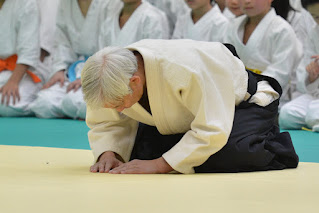
Etiquette is an integral part of any traditional budo. There is a saying: Budo starts and ends with courtesy. It is extremely important to follow etiquette rules, as they help practitioners to follow the martial path safely and with pleasure. Etiquette helps practitioners to be constantly aware and at the same time respectful to the partners, teachers, and students. Dojo where etiquette rules are optional often lose the spirit of budo.  In our Aikido school everyone is expected to follow the traditional rules of etiquette. The following points are important but not exhaustive rules. You should watch how do other people behave and listen to the teacher.  Good manners in dojo:   The third Doshu Moriteru Ueshiba performs sitting bow. Demonstrations at 20th Anniversary of Osaka Aikijuku Dojo. Take off your shoes before entering tatami area. Sit on your knees and bow to kamidana - central area with Japanese writings on the wall.  Clean the mats before practice. Do not res...

What does word 'Aikido' mean?

Image
Ai-Ki-Dou Some people translate the word 'Aikido' as 'Way of Love and Harmony' because Ai means Love in Japanese. But it is important to know how the word is written to correctly translate it from the Japanese language. The word 'Aikido' consists of three charterers 合 (Ai), 気 (Ki), and 道 (Dou). 合 (Ai) is conjunction, synthesis, meeting, harmony, unifying. (The word Love is written using totally different character 愛); 気 (Ki) means spirit, mind, intention; 道 (Dou) is way, path. So Aikido can be translated as the 'Way of Harmony of Minds'. It is difficult to choose one and only correct way to translate this word, because in Japanese all versatility of meanings combined in one character. Therefore everyone can interpret it slightly differently, but in all cases it will be something about unification of actual or spiritual movements or intentions. 

What is Aikido?

Image
Morihei Ueshiba Aikido is not a sport, not system of self-defence nor gymnastics. Aikido is budo, literally “the martial way” implying a martial discipline for character development practiced as a lifelong pursuit. Practitioners of budo develop technical martial skills while striving to unify of mind, technique and body, develop their character, enhance their sense of morality, and cultivate a respectful and courteous demeanour. Thus, budo serves as a path to self-perfection. Aikido was created in the first half of 20 century by Morihei Ueshiba (1883~1969), a master of traditional weapons and empty-handed ju-jutsu techniques including notorious  Daito-ryu Aiki Ju-Jutsu . The main feature of Aikido is blending with the power or motion of the attacker and redirecting the force of the attack rather than opposing it head-on.  Aikido practitioners develop physical and mental strength through repetitive practice, without rushing and competitions, according to their proficiency leve...